From the sugar beet to sugar
![Smiling woman applying face cream in a bright bathroom [no AI]](https://cdn.prod.website-files.com/690a64e4e086fc7e7a30737e/69903ce90e1bfdecac444ec3_personal%20care.avif)
Sugar beet cultivation throughout the year
Sugar beet cultivation has a very long tradition in Europe and has developed into a highly specialised sector of industry in recent years.
AGRANA has a contractual partnership with farmers, which governs the cultivation and purchase of the agreed quantity of sugar beet. Good cooperation and a long-term partnership between AGRANA and the beet farmers are essential for achieving optimal yields.
GMO-free through our own seed
Together with the beet farmers of Österreichische Rübensamenzucht GmbH, AGRANA ensures the unadulterated development of the genetic material through its own beet seed propagation and processing at the Tulln site. In order to award the ‘Produced without genetic engineering’ certification mark, the inspection bodies authorised by the Working Group for Genetically Modified-Free Food (ARGE Gentechnik-frei for short) have verified that the strict criteria of the Austrian Food Codex for genetically modified-free agriculture and food processing are consistently adhered to throughout AGRANA’s sugar production. The ‘Produced without genetic engineering’ quality seal certifies that the traditional Wiener Zucker brand guarantees the absence of genetic engineering throughout the entire value chain.
Domestic sugar for Austria
In Austria, sugar is produced from domestic sugar beet. After the autumn harvest, the beet is transported from the fields to the AGRANA sugar factory in Tulln for processing. There, the sugar beet is processed into high-quality sugar, either for the end consumer (Wiener Zucker) or for the food processing industry. However, before the sugar beet reaches the sugar factory, many steps are required, from cultivation to harvest.
The four seasons of the sugar beet
Discover our broad range of modified starches, designed to deliver performance, consistency, and innovation. From food and beverages to paper, textiles, adhesives, and construction, our solutions offer versatile functionality to meet diverse processing needs and product requirements across industries.
Depending on weather conditions and soil moisture, sugar beet seeds are sown from mid-March through mid-April. The Austrian Beet Seed Breeding Program (Österreichische Rübensamenzucht) produces the beet seeds sold and used in Austria. Herbicides and mechanical methods are used to protect the beet fields from weeds. To ensure maximum effectiveness, weeds are treated at the cotyledon stage whenever possible.
During the growing season, the growth of sugar beet plants can be hampered by weeds, diseases and pests. Cercospora leaf spot is the most significant leaf disease affecting sugar beet cultivation in Europe. To maintain yield potential, AGRANA operates the Cercospora monitoring system www.betaexpert.at, through which farmers regularly check their fields for diseases and record their fungicide treatments.
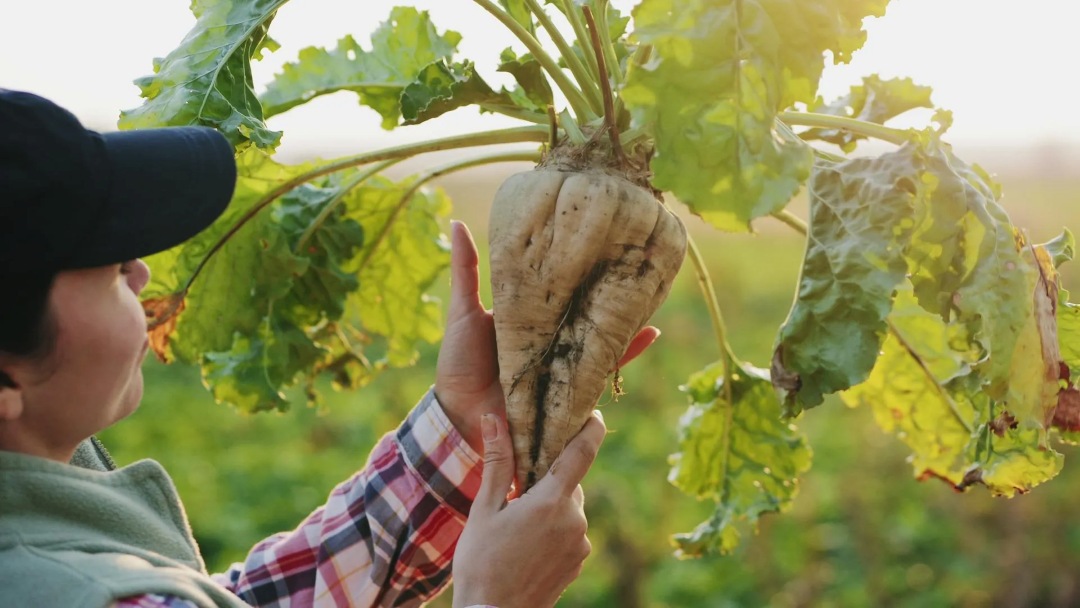
The sugar beet harvest begins in mid-September and is completed by mid-December. At harvest time, a single sugar beet weighs between 0.7 and 1 kg and consists mainly of water and around 15–19 per cent sugar. On average, 68 to 85 tonnes of sugar beet can be harvested from one hectare, yielding up to 14 tonnes of sugar. The leaves removed during harvesting, as well as the washed-off soil, are left in the field. The fertilisers produced during the subsequent production process are also returned to the field. This is circular economy in action.
The harvested and stored sugar beet is now processed at the sugar factory. In sugar beet logistics, particular emphasis is placed on keeping transport distances as short as possible and ensuring ‘just-in-time’ delivery. The AGRANA Raw Materials Department’s winter meetings in January offer all sugar beet farmers the opportunity to obtain first-hand specialist information for the new growing year.